The National Concept for Regional and Spatial Development by 2040 aims to reduce territorial imbalances in the country
The National Concept for Regional and Spatial Development by 2040 aims to reduce territorial imbalances in the
By Ministry of Regional Development and Public Works
Reducing territorial imbalances in the country and achieving a more balanced, competitive and sustainable development of all regions with improved living standards and access to quality services for all citizens. This is envisaged by the draft National Concept for Regional and Spatial Development of the Republic of Bulgaria for the period 2026-2040 (NCRRP). The strategy paper was developed by the Ministry of Regional Development and Public Works (MRDPW) with funding from the Regional Development Programme 2021-2027. It sets out the long-term vision, objectives and priorities for development throughout the country and builds on the previous concept for the period 2013-2025 with new tools and measures tailored to contemporary challenges – demographic change, regional imbalances and accelerated green and digital transitions in the EU.
The NDRC includes four strategic objectives: territorial cohesion, economic cohesion, social cohesion and growth, and environmental sustainability. The structure has been optimised compared to the previous National Spatial Development Concept 2013-2025, in order to improve the clarity and implementation of the regional development policy. Within this more concentrated framework, a new ‘Green Sustainability’ objective is also included, reflecting the accelerated green and digital transitions and the need to give these processes a clear territorial dimension. The strategic part thus both ensures continuity and integrates new priorities at European and national level.
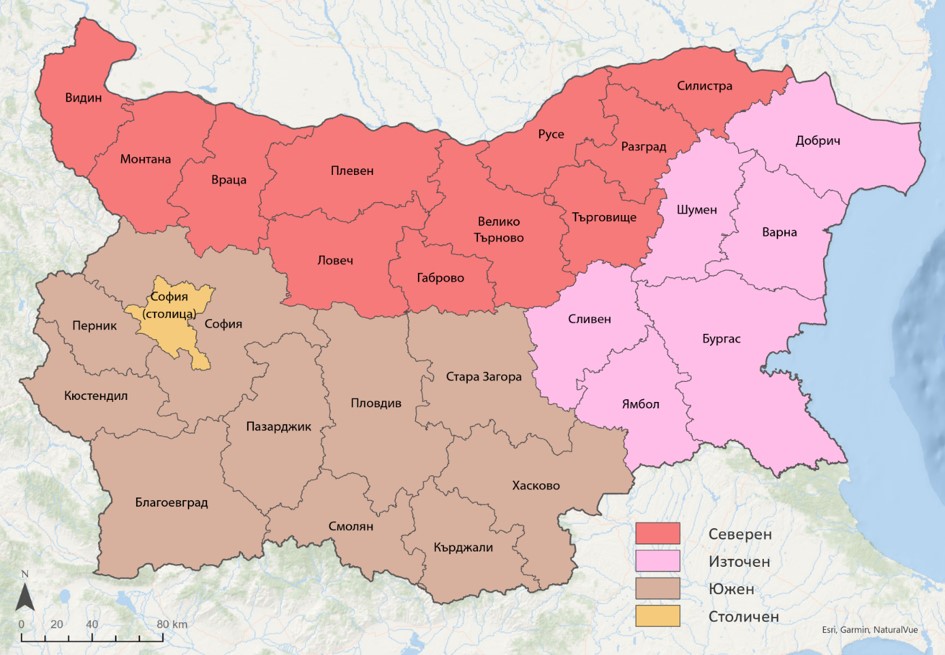
It takes into account the process of implementing the change in the scope of Level 2 planning regions, which is expected to be completed in early 2027, so that the proposed territorial models, priorities and indicators are compatible with the new configuration of Level 2 planning regions and provide a sound basis for future regional strategies and programmes. The country is structured into four Level 2 planning regions – North, East, South and Sofia. This action represents a step towards increasing the effectiveness of the regional development system and reflects the state's desire to provide a legal and political framework for regional development. The new zoning will allow for more precise and targeted investment, infrastructure and innovation policies. Reducing the number of level 2 regions by bringing together territories with similar characteristics is expected to contribute to more efficient resource planning and management, reducing intra-regional imbalances, increasing the competitiveness and resilience of regions in a national and European context.
Territorial cohesion aims to strengthen the network of city centres, improve connectivity and functional integration between territories and increase the active participation of Bulgarian regions in European and cross-border spaces. Economic convergence will promote economic growth and make more effective use of the endogenous potential of regions through investment, innovation and increased productivity, with a focus on narrowing economic disparities. Social cohesion and growth aims to reduce social inequalities, adverse demographic trends and unequal access to services by developing human capital and improving the quality of the living environment. Environmental sustainability focuses on integrating the climate and environmental aspects as a horizontal principle in all policies with a territorial dimension.
The concept will play a key role in the programming of cohesion policy post-2027 and in shaping national strategic priorities for territorial development. Priorities include investing in people, regions and institutions, supporting regional cohesion, reducing disparities between regions, education, skills and social inclusion. The ambition is the region of Sofia to establish itself as a leading center in Southeastern Europe, and the other regions to approach European standards.
Particular attention is paid to territorial cohesion through effective links between regions, improved transport and digital connectivity and sustainable use of natural, cultural and human potential. Strategic coherence between the different levels of government – national, regional and local – is ensured. Regional and cross-border cooperation, strengthening the territorial dimension of sectoral policies, cross-sectoral coordination, the development of a polycentric model with hierarchical city centres and the effective implementation of the integrated territorial approach shall be encouraged.
The concept includes policies such as integrated spatial planning (inclusion of the territorial aspect in all sectoral policies), equal development opportunities for all citizens, support for green technologies, circular economy, decarbonisation, resource efficiency and management of environmental, landscape and cultural values in a territorial context.
A system of monitoring indicators – demographic, social, economic, infrastructure, environmental and spatial – has been developed, allowing for tracking progress towards the 2030 and 2040 targets and timely adjustments.
Sources of funding can be the state budget, municipal budgets, private funds, EU funds, financial instruments and international financial institutions; the specific resources will be described in the regional and municipal plans.