With the motto: "Bridging Regions, Building Cohesion: A Stronger Danube for All” the second Bulgarian Presidency of the EU Strategy for the Danube Region was launched
With the motto: "Bridging Regions, Building Cohesion: A Stronger Danube for All” the second Bulgarian Presiden
By Ministry of Regional Development and Public Works
e4907547fadc683d27e123073159ee69.jpeg)
5cdd72bec05daea54f78cd2e8a4bbe70.jpeg)
0f6a3b89c7ebf92de3990eb4c362a6c3.jpeg)
50d67f8a5688921a66bb1a688b5685f4.jpeg)
9ba89922ee6aed50c331cfd9a444664e.jpeg)
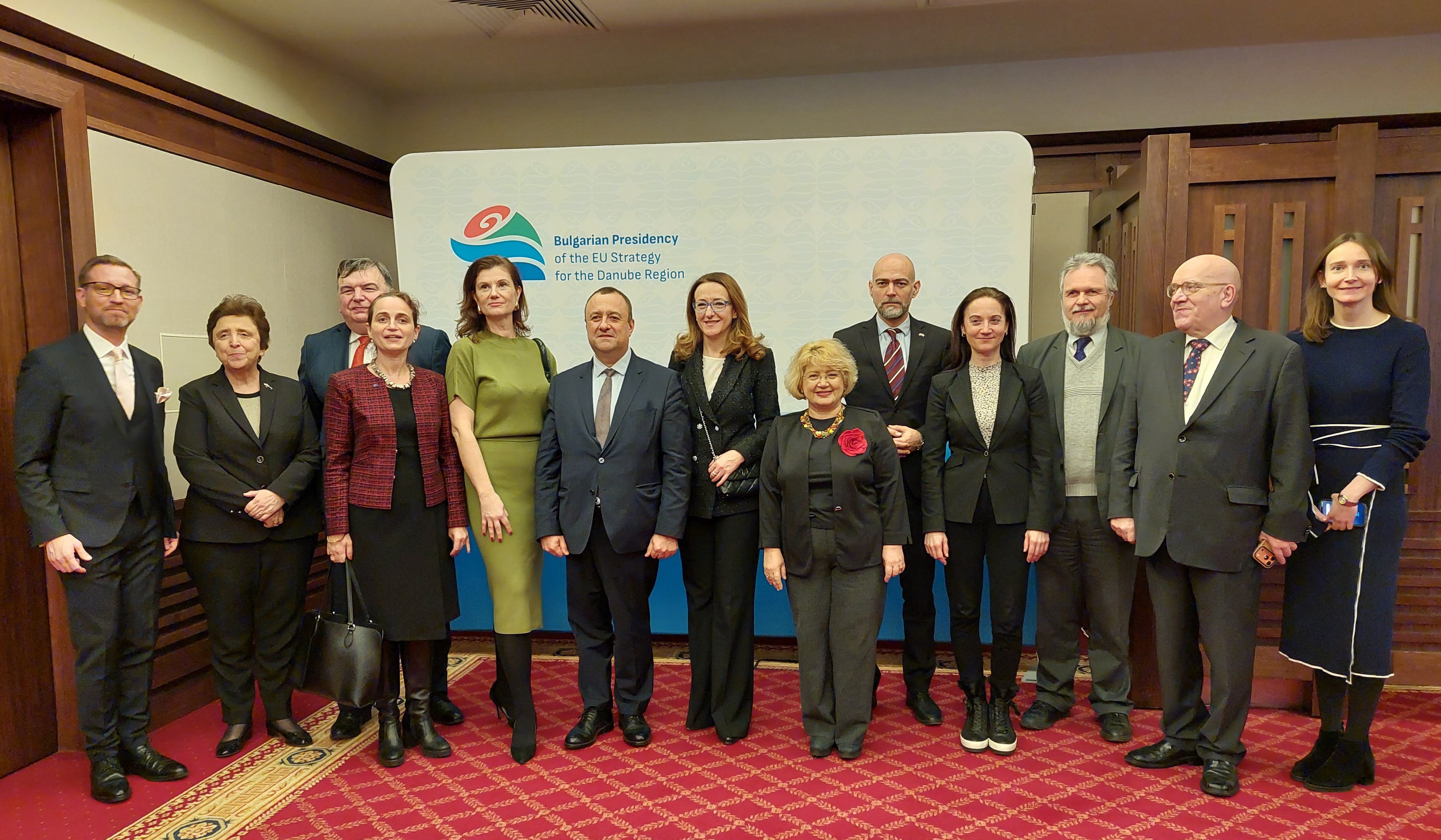
Minister Ivan Ivanov presented the priorities of the Presidency to the ambassadors of the countries along the river
On 1 January 2026, Bulgaria took over the Presidency of the EU Strategy for the Danube Region for the second time. This the year, the countries participating in the Strategy will be united by the motto "Bridging Regions, Building Cohesion: A stronger Danube for All’.
"Since its endorsement by the Council over 15 years ago, the Strategy has been actively working to harness the potential of the Danube region and to support efforts to overcome the economic crisis in a sustainable manner, improve socio-economic development, competitiveness, environmental governance and resource-based growth, modernise transport corridors and enhance security". This was stated by the Minister of Regional Development and Public Works Ivan Ivanov at a meeting with the ambassadors from the countries located along the Danube. Before them, he stressed that: “The coordination mechanism established by Bulgaria to ensure the effective participation in the Strategy represents an instrument of long-term value, but also an opportunity for strategic planning, alignment of visions and stronger cooperation among institutions.”
The Minister also said that for Bulgaria the added value of the Danube Strategy lies in the partnership and interaction in the implementation of joint strategic projects, and "that specific support for projects from the Danube region is provided within the framework of our operational and territorial cooperation programmes, through the envisaged possibility to give priority to projects whose activities contribute to achieving the objectives of the Danube Strategy."
Ivan Ivanov pointed out that over the years the priorities of the Danube Strategy have evolved, but they need to be updated and transformed to meet the new challenges faced by the countries in the region. "Tackling them requires mobilising strong political support from all countries and institutions at European, macro-regional and national level, securing substantial investment for their implementation and achieving visible results for the people of the region. In these processes, countries rely on the strong support of the European Commission," he stressed.
Minister Ivanov said that Bulgaria’s Presidency of the Danube Strategy provides our country with an opportunity to focus on the potential of the Danube region, because ‘the Danube is more than a river – it connects different peoples and their cultures and is a path to our common future. It reminds us that progress comes when we move together.”
During the meeting the National Coordinator of the Danube Strategy for Bulgaria Vyara Mincheva presented to the participants the main priorities of the Bulgarian Presidency.
Mincheva highlighted the reduction of disparities through increased convergence and integration, with a focus on regional inequalities as a challenge to competitiveness and stability, as the main element of the Presidency’s political focus; she also emphasised the role of cities as drivers in reducing disparities and advancing social cohesion, skills and cultural connectivity.
Vyara Mincheva pointed out that among the priorities of the Bulgarian Presidency are also topics such as increasing demographic and territorial resilience, as well as strengthening cooperation with EU candidate countries. She expressed the intention that the Bulgarian Presidency would highlight the added value of macro-regional strategies in the ongoing discussions on the new financial framework of the European Union post-2027. Among the objectives is also to serve as a platform for dialogue between EU institutions, national authorities, regional authorities and regional stakeholders "in order for the Danube Strategy to further strengthen its role as a catalyst for integrated, inclusive and impactful development across the Danube region."
The EU Strategy for the Danube Region is a cooperation instrument covering 14 countries – Bulgaria, Austria, Croatia, Czechia, Germany, Hungary, Romania, Slovakia, Slovenia, Bosnia and Herzegovina, Montenegro, Serbia, Moldova and Ukraine. They are home to 115 million people, or one-fifth of the EU’s population. Bulgaria coordinates two priority areas covering security, culture and tourism.