Minister Nikolay Naydenov: It is imperative to immediately start working on a new National Housing Strategy
Minister Nikolay Naydenov: It is imperative to immediately start working on a new National Housing Strategy
By Ministry of Regional Development and Public Works
e76d74f522660d7b7a6ebac4934a01ba.jpeg)
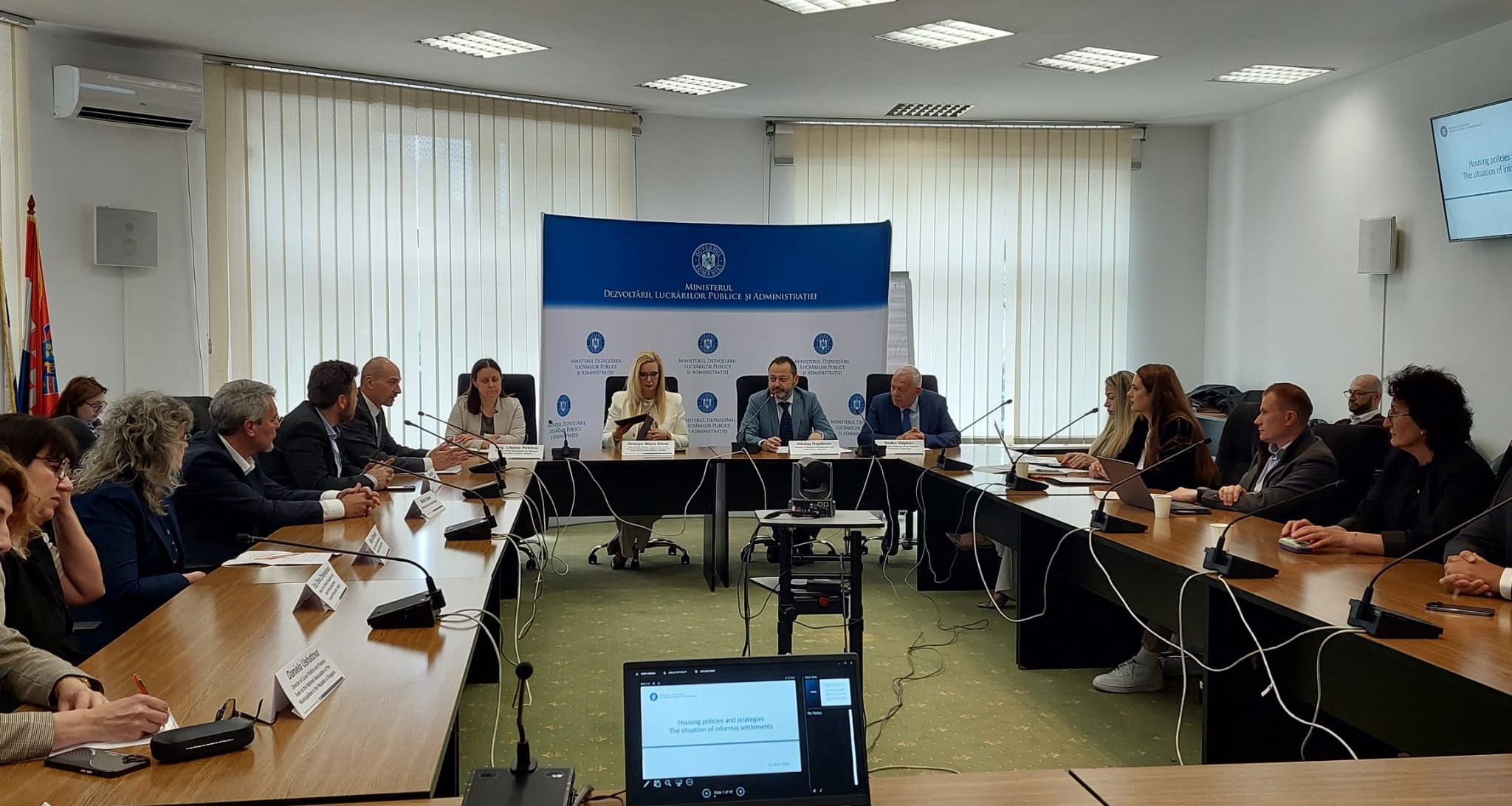
The elaboration of the new national housing strategy of Bulgaria is to be commissioned. In the assignment for this strategy, we will focus on the problems regarding social housing and neighbourhoods, defined by data and research - socio-economic, statistical, spatial, territorial-structural, sociological, financial and successful practices. This was announced by the Minister of Regional Development and Public Works Nikolay Naydenov. In Bucharest, Romania, the Minister participated in a meeting on the implementation of the Law on the Planning of the Territory of our Neighbouring Country, which also regulates the planning of informal settlements.
Naydenov pointed out that the Bulgarian Spatial Planning Act regulates both the structural rules for the settlement of marginalized urban structures and the so-called social housing with reduced norms. However, he expressed dissatisfaction with the pace and manner in which these settlements are developing. He added that more effort was needed.
During the meeting, experts from different departments of Romania presented the country's experience with the structure of informal settlements and work on improving housing conditions for socially vulnerable groups.
It became clear that over the past 10 years, serious efforts have been made in Romania to create legal norms that would also include informal settlements. According to initial data, 72,000 people live in such settlements. Due to difficulties in identifying them, the number is expected to be higher. Experts pointed out that it is necessary to collect sufficient data, because first it is necessary to determine what the measures should be and then to implement them. For this purpose, a digital platform is made about the different territories of Romania, in which a separate part is about informal settlements.
The term informal settlements in Romania was introduced in the Law on Spatial Planning in 2019, and in 2020 the norms for its implementation were published. It distinguishes between informal settlements and illegal construction, because the goal is to help the vulnerable part of the population, and not to those who were looking for a way to avoid the law. In our neighboring country, the term "housing of a social nature" has also been introduced. The minimum necessary living area for one person of 15.33 square meters is also regulated.
During the conversation, it became clear that Romania started to address the topic of affordable housing, which is now relevant at EU level, in 2022. The country has adopted a National Housing Strategy 2050, which prioritises vulnerable populations, including informal settlements, and the provision of affordable housing for every citizen. There is an opportunity to buy social housing.
Separately, to enhance the role of local authorities, 42 strategies have been introduced at regional level, exclusively for cities and villages with over 20,000 inhabitants. 30 of these strategies have a social housing component of €22 million for purchase, renovation and modernisation. The goal is to provide living space for 550 people. In our northern neighbor there is a big difference between the supply and demand of social housing. There are serious problems in major‑ cities in Romania and approaches are being sought to activate empty housing due to migration.
The 2021-2027 housing, social inclusion and services programmes in Romania amount to a total of EUR 500 million. In order to speed up their implementation, the involvement of private organisations has been introduced. One of them envisages about EUR 100 million for the renovation, modernization and purchase of housing and about EUR 38 million for the regulation of informal settlements. These programs are being implemented in about 200 informal settlements, with the aim of helping about 70,000 people and increasing the housing stock so that it can be used by about 5,600 more people.
Another initiative will provide integrated social services in 2,000 settlements or 70% of rural territories in Romania over the next six months, including informal settlements. Teams of specialists in the health, education and social fields will work together on social assistance contracts at Community level. The Community aid package includes several criteria – improving living conditions, making small or urgent repairs for socially vulnerable people (small furniture sets for learning children, adapting spaces with kitchen or bathroom), helping to obtain personal documents and helping to find a job. The average investment amounted to €354,000 per community.
One of the challenges for the country is not to raise house prices because of the green transition. Another problem is access to public transport, one of the conditions for a decent life, alongside access to housing, education, healthcare and quality services. Among the most‑ important tasks for the next period is the experience gained to be developed and implemented even more‑ actively, in accordance with the next financial framework.
The experience-sharing meeting was organised by the Habitat Bulgaria Foundation. It was attended by the head of NCSD Eng. Lilyana Petrova, the Mayor of Slatina, Georgi Iliev, representatives of the municipalities of Kyustendil and Berkovitsa (working under the Home Equals project), the Director of Habitat Bulgaria, Mincho Benov, representatives of the foundation and the National Association of Municipalities in the Republic of Bulgaria. The experience of Romania was presented by representatives of the Ministries of Development, Public Works and Administration; investment and European projects; of work, family, youth and social solidarity; by the Association of Municipalities of Romania, Habitat Romania and others. As a result of the work done so far in Romania is already regulated the first informal settlement - Resica.
The renovation of informal neighbourhoods by 2030 is one of the leading sustainable development goals in UN Agenda 2030, also signed by Bulgaria. There are over 200,000 illegal homes in Bulgaria, mostly in neighbourhoods with a predominantly Roma population, with partial or no spatial planning. The project ‘Home Equals – Improving housing conditions in illegal neighbourhoods’ of Habitat Bulgaria, with pilot municipalities Kyustendil and Berkovitsa, aims to influence national policies related to informal neighbourhoods by taking concrete steps to ensure spatial planning and housing status in them and creating conditions for the construction of basic infrastructure. The project is part of the global Home Equals campaign aimed at improving living conditions in illegal neighborhoods around the world.