Deputy Minister Radoslav Rusev: Building information modeling in Bulgaria will contribute to greater transparency in construction and competitiveness of companies
Deputy Minister Radoslav Rusev: Building information modeling in Bulgaria will contribute to greater transpare
By Ministry of Regional Development and Public Works
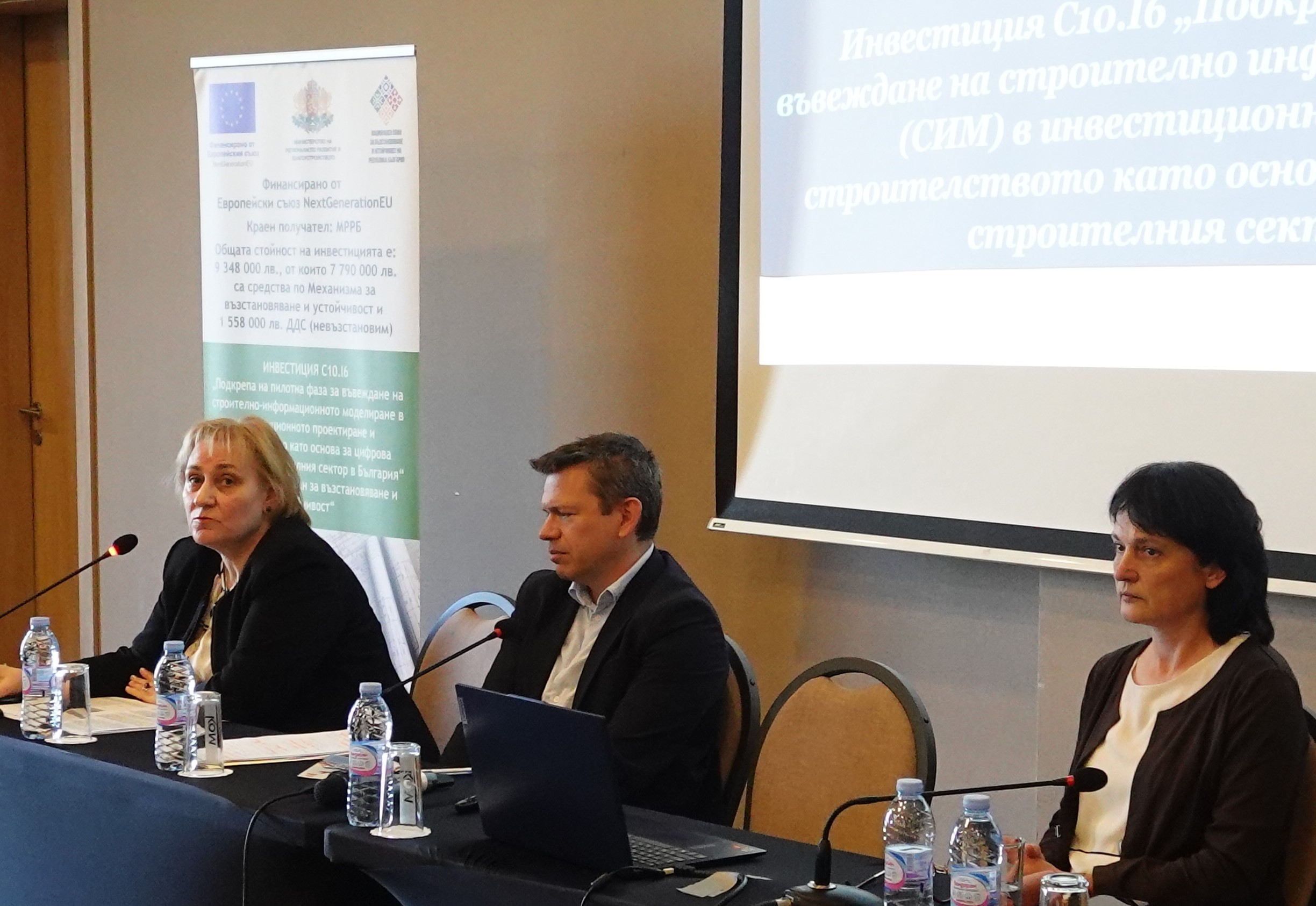

The implementation of building information modelling (BIM) in Bulgaria should be among the priorities in the coming months as a basis for long-term digital reform in the construction sector. This was said by the Deputy Minister of Regional Development and Public Works Radoslav Rusev, who opened a final information event to present the results achieved from the implementation of Investment C10.I6 ‘Supporting a pilot phase for the introduction of building information modelling (BIM) in investment design and construction as a basis for digital reform of the construction sector in Bulgaria’. The project of the Ministry of Regional Development and Public Works is financed by the National Recovery and Resilience Plan. The forum with the participation of experts and representatives of various departments and the construction industry was held in Sofia.
Deputy Minister Rusev stressed that the system will contribute to greater transparency, standardisation and predictability of processes, making buildings and infrastructure more manageable and predictable, including in terms of life-cycle costs. “In the coming years, construction processes will change a lot, with topics such as information modelling, nature-based solutions and geoengineering to tackle the challenges we face,” he said. Deputy Minister Rusev highlighted the importance of digital models and "digital twins" for more efficient management and operation, as well as the potential for increasing the competitiveness and sustainability of Bulgarian construction companies in the country and the region. According to him, BIM will also support the construction of more sustainable and adaptable to climate and economic challenges infrastructure. “The good thing is that it covers all the actors involved in the construction process – design, construction, academic community, infrastructure users. The projects will now be like in the palm of our hand and we will have a detailed look", the Regional Deputy Minister further said and gave an example with the plumbing systems, which will be visualized more easily and in detail. “We have a purely Bulgarian product that will make our work with the Spatial Planning Act much easier,” he further stressed.
Investment C10.I6 ‘Supporting a pilot phase for the introduction of building information modelling (BIM) in investment design and construction as a basis for digital reform of the construction sector in Bulgaria’ under the NRRP covers seven interlinked activities implementing measures from the Roadmap to the National Strategy for Digital Transformation of the Construction Sector adopted in 2023.
Under the first activity, specialized trainings are carried out in accordance with European standards and good practices in the administration. More than 300 experts from state, regional and municipal administrations have already been trained. The second activity covers the hardware and software support of the administration, providing 300 jobs in 60 administrations to work with BIM projects. The third activity includes the creation of a web-based platform with training materials, guides and resources to support small and medium-sized enterprises. The fourth activity envisages the development of a national BIM model, as well as the preparation of legislative changes and guides for information management, sharing and security, in line with European standards. The fifth focuses on developing BIM-related curricula to be introduced in higher technical education institutions through cooperation with universities. For this purpose, framework agreements for cooperation between the Ministry of Regional Development and Public Works and 11 higher technical institutions in the country are in the process of being signed. The sixth activity envisages the construction of a software infrastructure for working with BIM projects, which will build on the future unified information system in the spatial planning and investment design, and the seventh is the management of the investment. Some of the activities have already been completed and others are in the process of being implemented, with the deadline for implementation of the investment being 30 June.
The 10-year horizon of the strategy aims to introduce BIM level 2. The project has clearly distinguishable data in a common environment in which the designers of all parts share documents, engineering networks, structural and architectural elements within the BIM model, work collaboratively and develop a unified BIM project that enables coordination, collision checking and design studies. Also, BIM level 2 will require the automatic preparation of construction schedules (4D) and design with a price parameter (5D), which will allow the preparation of quantified accounts of the investment project. The national strategy for the digital transformation of the construction sector by 2030 includes three phases for the introduction of BIM – Level 2. The first phase is in the period 2027-2030, which introduces a requirement to use BIM in public works contracts worth more than EUR 50 million. The second is expected to start in early 2030, including public works contracts worth more than EUR 20 million. The third phase will start in 2033. Its scope will be determined following an analysis and a performance study of the first two phases of the BIM implementation strategy.