Participants in the Danube Strategy Annual Forum Discussed How to Make Cities Attractive to People and Businesses
Participants in the Danube Strategy Annual Forum Discussed How to Make Cities Attractive to People and Busines
By Ministry of Regional Development and Public Works
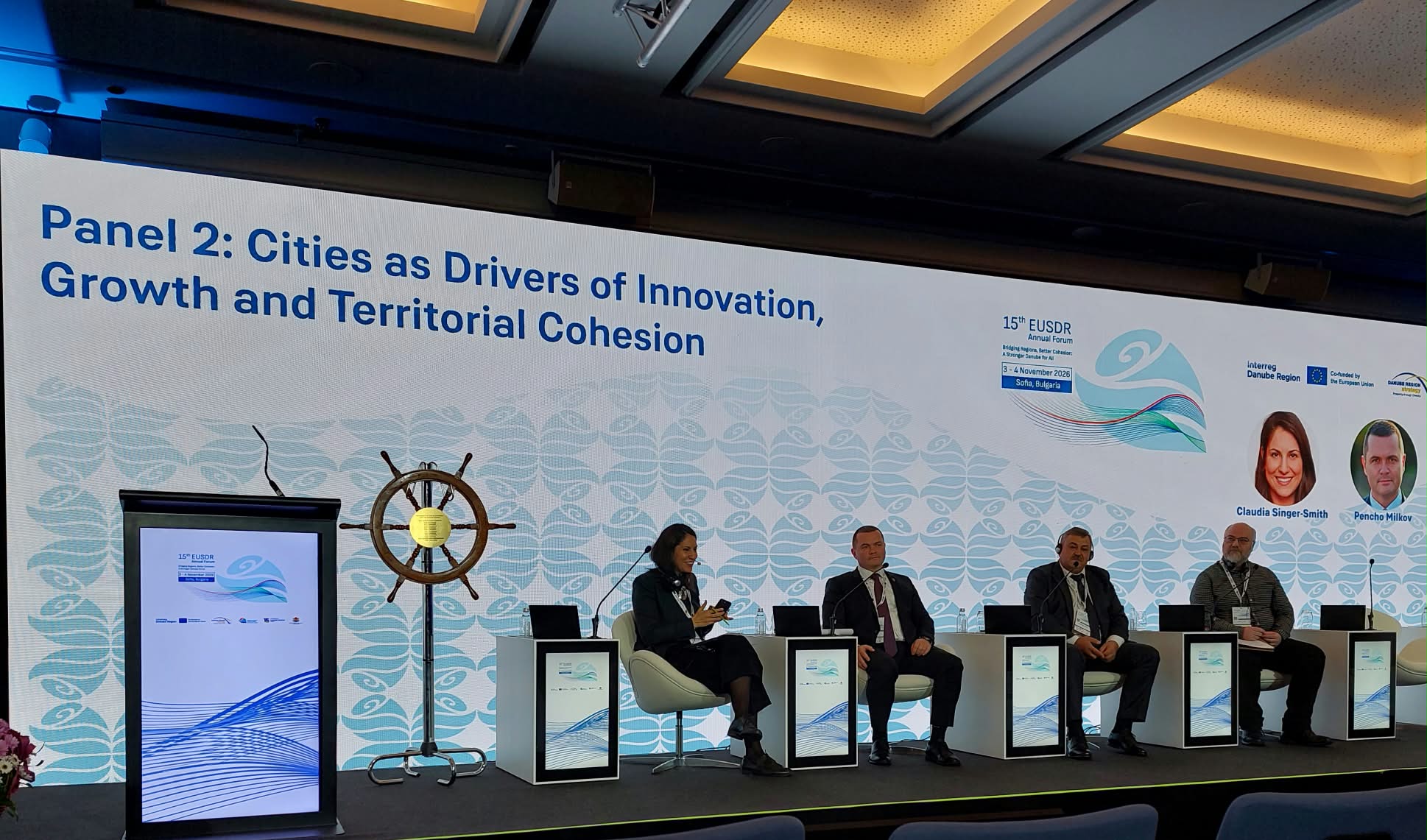
How can cities become more attractive to people and businesses? What can be done to encourage young people to stay and live and work in their hometowns? These were the questions discussed by participants in the panel entitled “Cities as Drivers of Development, Growth and Territorial Connectivity”, held as part of the 15th Annual Forum of the EU Strategy for the Danube Region.
Urban planner Ivaylo Stoyanov, Head of Department at the Directorate-General for Strategic Planning and Regional Development Programmes at the Ministry of Regional Development and Public Works, argued that cities and municipalities should not be supported in isolation, without taking neighbouring areas into account. Services that are unavailable in one city or municipality may be accessible in neighbouring areas. Therefore, it is important to identify and build on local strengths and specific characteristics, while seeking services and opportunities that are lacking in neighbouring territories.
As a good example, he pointed to the Integrated Territorial Investment concept in the field of healthcare in Bulgaria’s South-East Planning Region, where each municipality has identified its specific contribution to improving healthcare services across the region.
Stoyanov stressed that planning should focus on developing functional links between territories, making cooperation between local authorities essential. He also recommended that planning take into account the available funding capacity, with priority given to the most pressing needs and areas with the greatest potential.
He identified several challenges, including the technical and administrative capacity of smaller municipalities, the complexity of certain aspects of Cohesion Policy and the difficulties involved in cooperation. He emphasised that the Ministry of Regional Development and Public Works, which is responsible for regional development, is seeking to support municipalities in preparing for the new programming period through instruments such as technical assistance.
Ruse has the potential to offer transport connections with the whole of Europe, but its geographical advantages alone are not enough. The challenge today is to preserve industrial development while adapting to modern needs and creating opportunities for young people, said Ruse Mayor Pencho Milkov.
He noted that, in order to nurture a generation of innovators and dreamers, robotics is taught in every educational institution in Ruse. The mayor commented that infrastructure makes everyday life more convenient, but every young family must also feel secure and have their human rights respected.
He was adamant that civil society must be involved in addressing local issues and cited the city's Youth Parliament as an example. According to him, cities such as Ruse cannot set themselves the same goals as capital cities, but they can give young people confidence that their hometowns need them and offer opportunities for them to contribute.
The Mayor of the Ukrainian city of Horodenka, Bohdan Kobylianskyi, commented that people need affordable housing, security, resilient critical infrastructure and employment opportunities in order to stay in their hometowns. This is why the municipality is maintaining the quality of its educational services, for example, despite the declining population.
An industrial park has been registered and is expected to become operational after the war. Efforts are also being made to provide young people with career guidance and vocational orientation.
Mobility is essential for young people, emphasised Ivana Milošević from the Danube Youth Council. She explained that it is important for young people to have the freedom to choose where they study and work, while also having the opportunity to return and settle in their hometowns.
She stressed that this requires employment opportunities, quality public services and affordable housing. However, a sense of belonging is equally important to young people.
In her view, cities should cooperate rather than compete with one another, and innovation should therefore not be concentrated in a single location.